Welcome to Seawolves Legends, a series dedicated to honoring the individuals who have left an indelible mark on the Seattle Seawolves. From standout players to behind-the-scenes heroes, these stories highlight the passion, dedication, and heart that make the Seawolves family extraordinary.
On April 3rd, 2026, we honored Samu Manoa, a flanker nicknamed “The Hitman” for his bone-rattling tackles. Manoa built his career across England, France, and Wales before coming home to Seattle.
Raised in the Bay Area, Samu picked up rugby at age 13 under the guidance of his father and uncle, in a household where the sport was heritage. His grandfather captained Tonga in the 1960s, his father and uncles all played, and his uncle Willi even represented Australia.
Before going professional, Manoa worked in concrete, electrical contracting, and tree cutting. When he eventually signed with Northampton Saints in England, he became one of the first American players to break into a top European league at a time when few organizations were lining up to take a chance on U.S. talent.
The doubters showed up immediately. Fans on social media questioned the signing, openly wondering who this American was and whether he was worth the investment. Especially at the time, teams across Europe had little frame of reference for U.S. talent. Rugby wasn't televised broadly back home, and there was no Major League Rugby, no established pipeline, no proof of concept.
"I saw people saying I was a waste of money," Manoa recalls. "But that just motivated me to go out and make sure they knew who I was."
He did exactly that. From Northampton he moved to Toulon in France and then Cardiff Blues in Wales, competing at the top level in three different countries. France came with its own challenges, including the language barrier. The family was taking weekly classes, but their teacher happened to be Russian. They picked up her accent without realizing it.
"We'd go out to order food and people were looking at us like they had no idea what we were saying," he says, laughing. His daughter eventually became the family's unofficial translator.
At Northampton, Manoa and teammate Courtney Lawes became known as the "Smash Brothers." Then a highlight reel started circulating online, along with a new nickname: The Hitman.
It fit perfectly. "Every game I go into, I'm looking to hit someone hard," he says proudly. "I'm always chasing that next highlight."
That play style doesn’t let you leave scotch-free, of course. Manoa’s collected shoulder injuries, a broken forearm that needed a metal plate, and a gash from his ear down the side of his face, to name a few. He ran through this list calmly, like reading a grocery receipt.
"That's part of the game," he says. Nothing changed how he played. That was never an option.
Manoa’s time overseas was punctuated by an incredible moment of his playing career: captaining the United States at the 2015 Rugby World Cup. Leading the Eagles against South Africa – a Springbok side that would go on to be among the tournament's most powerful – was, by any measure, a remarkable occasion for American rugby.
His approach to captaincy mirrored his approach to everything: straightforward, actions-first, and rooted in the belief that the game should still be fun. He kept team talks simple, telling his teammates to enjoy themselves, shake off mistakes, and pick each other up. A captain who leads by example, he earns trust through what he does on the field.
"The ones who talk too much but don't show it on the field aren't the ones you want to follow," Manoa says.
Manoa joined the Seattle Seawolves in 2019 and brought with him years of experience at the highest level. He also brought a standard. That season ended with a championship, one of the defining moments in early Major League Rugby history, and Manoa played his part in a squad that delivered. He returned again in 2021, adding leadership and depth to the group a second time around.
With the Seawolves, Manoa was someone who raised the level around him. And somewhere in between the big tackles and the team meetings, he found time for his preferred pregame ritual: two Big Macs, two Filet-O-Fish, fries, and a Coke.
"In England, everyone's eating celery and peanut butter and protein shakes," he recalls. "The captain looked at me like I was crazy." He laughs. "But that's what I've always done. It worked for me."
Rugby is one of the most physical sports on the planet, but Manoa will tell you that's not what makes it special. What makes it special is the respect, on the field and off it.
"They call it a gentleman's sport for a reason," he says. "It's different from sports where there's a lot of trash talk and fighting after games. In rugby, you build real bonds. Teammates turn into family."
Those bonds run deep enough that when Manoa once went AWOL from a U.S. team flight – jumping off at a San Francisco layover after two years away from home, disappearing into a family barbecue that stretched past midnight while coaches frantically called his father and wife in France trying to locate him – his teammates covered for him as long as they could. He eventually boarded a 6 a.m. flight to Texas still in celebration mode, slipping into the hotel just as the team returned from morning training.
"That's one of the better stories I can share," he says (which raises questions about the ones he can't).
That's what rugby does. It creates the kind of relationships where you show up for each other, on the field and off it. For his last birthday, messages came in from around the world – former teammates, opponents, people he met along the way on five different stops across three countries. That’s the kind of loyalty that’s built over a career.
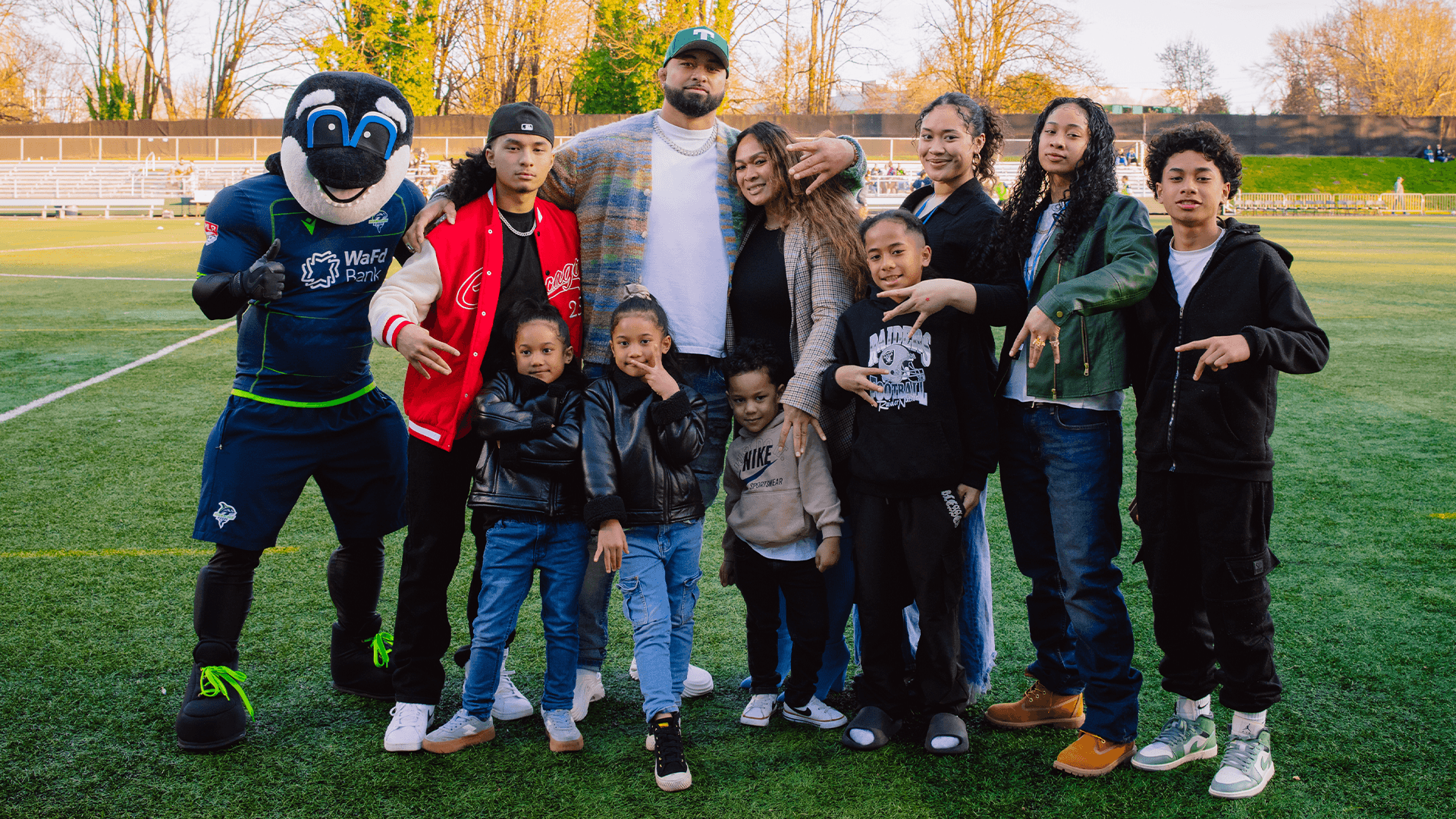
These days, Manoa's life is full in the way that only a person who has lived extensively abroad and raised eight children can claim. Four boys, four girls. The boys, aged 17, 12, and 10, are all playing rugby. So are the girls. When the family returned to the States after years in France and Wales, Manoa steered his kids toward American sports, figuring they'd been overseas long enough. Football and basketball had their moment. Rugby pulled them all back.
He runs a concrete business, a return to his pre-professional roots. He has also launched a sparkling wine company called Status, which has made its way into PGA Tour events, the ESPY Awards, NBA arenas, and soccer venues. The same competitiveness that chased big hits on the rugby pitch is now chasing market share.
As for coaching, Manoa is in conversations with Seattle. The Seawolves may not be done with him yet, nor he with them.
For young players, he advises the following: be coachable, stay confident, keep a positive attitude, be consistent. Rugby isn't for the weak. But it is, he insists, for almost everyone else, big or small, seasoned or raw, as long as they bring the courage to step up and make the tackle.
When Samu Manoa thinks about how he wants to be remembered, he says simple this: Someone who loved the game, loved to hit, and gave the fans a show every time they came out.
He helped open doors for American players overseas at a time when those doors were barely ajar. He competed at the highest levels across three countries. He brought that experience back to Major League Rugby and delivered a championship in its early, formative years. And through all of it, he never changed his approach, his pregame order, or his fundamental belief that the best thing you can tell a rugby team before a match is simply to go out and have fun.
For those who saw him play, that's exactly what he was, and then some.
Samu Manoa was inducted as a Seattle Seawolves Legend on April 3, 2026.